
Crochet Midi Skirt Pattern: A Free A-Line Skirt in 4 Sizes
This free crochet midi skirt pattern creates a gently flared skirt with simple stitches and a comfortable elastic waistband. The understated shape is easy to style with a tucked-in T-shirt, a light sweater, or your favorite denim jacket.
Soft taupe gives the skirt a versatile everyday look, while the horizontal crochet rows add just enough texture. Choose another solid color to make a piece that works with your own wardrobe.
This is a confident-beginner project. You will work joined rounds, make evenly spaced increases, and fold a simple waistband casing around elastic. The instructions include four sizes and explain how to adjust the length.
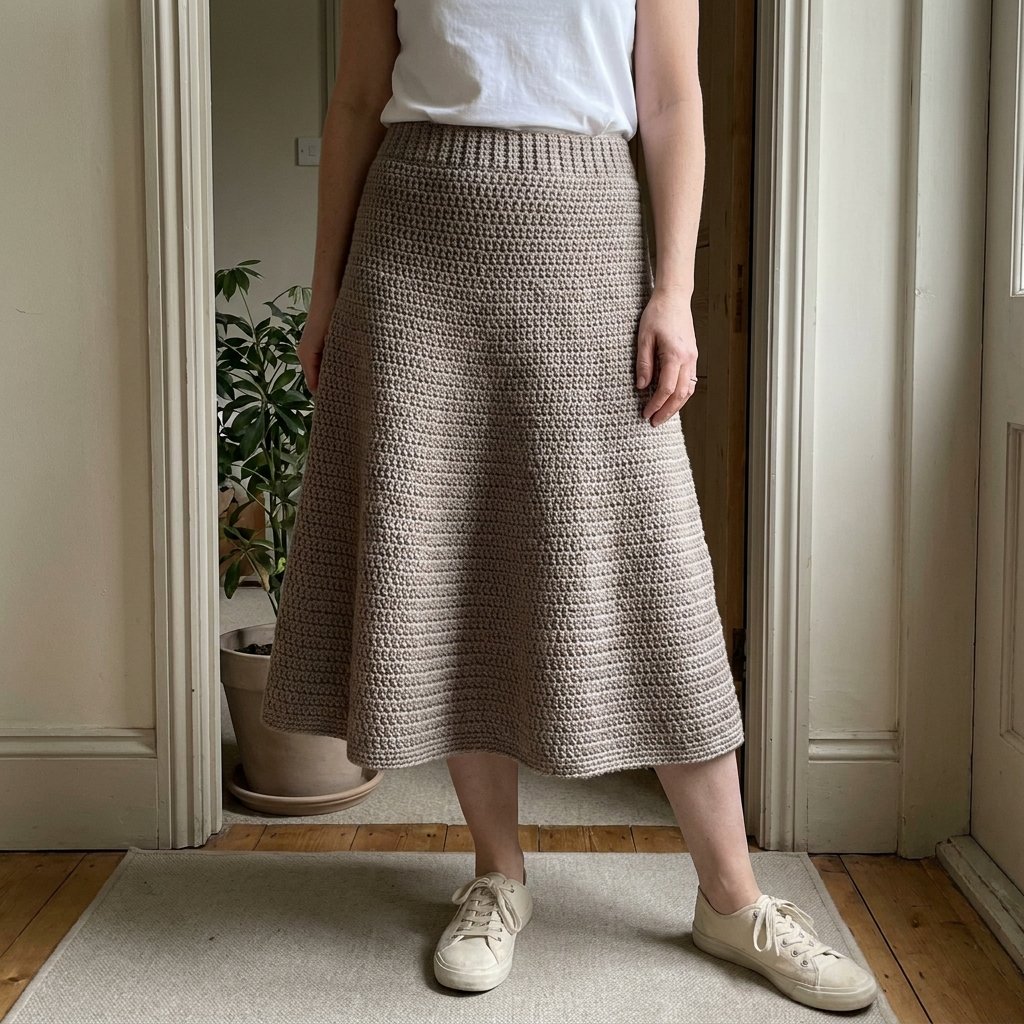
Table of Contents
Crochet Midi Skirt Pattern: A Free A-line Skirt In 4 Sizes Instructions
Project Details
- Skill level: Confident beginner.
- Estimated time: Approximately 25–40 hours, depending on size and crochet speed.
- Sizes: A, B, C, and D; choose using your actual hip measurement.
- Finished length: Approximately 25.75 inches (65.5 cm), adjustable.
- Crochet terminology: US terms.
- Construction: Worked from the waistband down in joined rounds, with gradual increases for an A-line shape.
- Waistband: Folded crochet casing with enclosed elastic.
This is an original Cute Stitch Studio design inspired by a classic A-line silhouette. It has not been physically sample-tested. Measurements and yarn quantities are estimates based on the stated gauge.
Choose Your Size
Measure around the fullest part of your hips while wearing the undergarments you plan to wear with the skirt. Choose a finished upper-skirt circumference approximately 2–4 inches (5–10 cm) larger than that measurement.
The crochet waistband must slide over your hips before the elastic gathers it at your waist. Do not choose the crochet size from your waist measurement alone.
| Measurement | Size A | Size B | Size C | Size D |
|---|---|---|---|---|
| Suggested body hip | 36–38 in (91.5–96.5 cm) | 40–42 in (101.5–106.5 cm) | 44–46 in (112–117 cm) | 48–50 in (122–127 cm) |
| Finished upper-skirt circumference | 40 in (101.5 cm) | 44 in (112 cm) | 48 in (122 cm) | 52 in (132 cm) |
| Finished hem circumference | 56 in (142 cm) | 60 in (152.5 cm) | 64 in (162.5 cm) | 68 in (172.5 cm) |
| Finished length | 25.75 in (65.5 cm) | 25.75 in (65.5 cm) | 25.75 in (65.5 cm) | 25.75 in (65.5 cm) |
For measurements between the suggested ranges, compare your hips directly with the finished circumference. For example, a 39-inch hip measurement has 5 inches of ease in Size B. This creates a slightly roomier skirt.
The elastic length is customized separately. The waistband will have gentle gathers, especially when your waist is much smaller than your hips.
Materials
- DK-weight yarn in taupe or your preferred color; see estimated quantities below.
- 4 mm crochet hook, or the size needed to match gauge.
- 1-inch-wide (2.5 cm) washable waistband elastic, enough to go around your waist plus an overlap allowance.
- Yarn needle.
- Sewing needle and matching sewing thread for joining the elastic.
- Scissors.
- Measuring tape.
- One locking stitch marker.
- One large safety pin for threading the elastic through the casing.

Hook Size
Start with a 4 mm crochet hook. Gauge determines the finished size, so adjust the hook if needed.
If you have too many stitches in 4 inches, try a larger hook. If you have too few, try a smaller hook. Recheck after washing and drying your swatch.
Yarn
Use Category 3, DK-weight yarn. A smooth cotton-acrylic blend is a practical starting point for a skirt with visible stitch definition and some drape. Check that you like the washed fabric before buying yarn for the whole project.
- Size A: Approximately 1,400 yards (1,280 m).
- Size B: Approximately 1,550 yards (1,420 m).
- Size C: Approximately 1,700 yards (1,555 m).
- Size D: Approximately 1,850 yards (1,690 m).
These are purchasing estimates, not measured sample usage. Buy extra if you plan to lengthen the skirt, and keep all yarn from the same dye lot when possible.
Taupe, oatmeal, chocolate brown, navy, and dusty rose all suit the simple shape. A solid color makes the shaping and stitch counts easier to follow.
Gauge
Body gauge: 18 double crochet stitches and 10 rounds = 4 inches (10 cm), after washing and drying flat.
Waistband gauge: 18 single crochet stitches and approximately 20 rounds = 4 inches (10 cm). Use a different hook for the waistband if needed to match its stitch width.
Make a generous swatch in joined rounds, without turning, to match the construction of the skirt. Measure away from the starting edge and join. Test both stitch patterns.
Then hang the dry swatch for several hours and measure again. If the fabric lengthens noticeably, account for that growth before deciding where to finish your skirt. A heavy crochet garment may hang differently from a small swatch.
Abbreviations
- ch: chain.
- sc: single crochet.
- dc: double crochet.
- sl st: slip stitch.
- st(s): stitch(es).
Increase: Work 2 dc into the same stitch. Each increase adds one stitch to the round.
Before You Start
- Instructions list sizes in this order: A (B, C, D).
- Work in joined rounds without turning.
- Beginning ch-1 and ch-2 do not count as stitches.
- Work the first stitch of each round into the same stitch as the joining slip stitch.
- Join to the first actual stitch, never to the beginning chain.
- Do not work into the joining slip stitch.
- Place the marker in the first stitch and move it up each round.
- Keep the beginning of the round at the center back when wearing the skirt.
The waistband and body have separate round numbers. After completing the waistband, restart at Body Round 1.
The design has no slit, pockets, drawstring, or separate closure. The gradual flare provides room through the lower skirt. Check your own walking and sitting comfort before finishing.
Crochet Midi Skirt Pattern: Step-by-Step Instructions
Part 1 — Crochet the Waistband Casing
Foundation: Loosely ch 180 (198, 216, 234). Check carefully that the chain is not twisted, then sl st into the first chain to form a ring.
Waistband Round 1: Ch 1. Sc in each chain around. Join with a sl st to the first sc. 180 (198, 216, 234) sts.
Waistband Rounds 2–15: Ch 1. Sc in each stitch around. Join with a sl st to the first sc. 180 (198, 216, 234) sts each round.
The waistband should measure approximately 3 inches (7.5 cm) tall before folding. If your single crochet round gauge differs, add or remove plain rounds to reach this height.
Before continuing, gently try the band over your hips. It should pass comfortably without straining the foundation chain. If the chain is noticeably tighter than the fabric, remake it more loosely before adding the skirt body.
Leave the casing unfolded and keep the yarn attached. You will fold it inward and insert the elastic after blocking the skirt.
Part 2 — Start the Upper Skirt
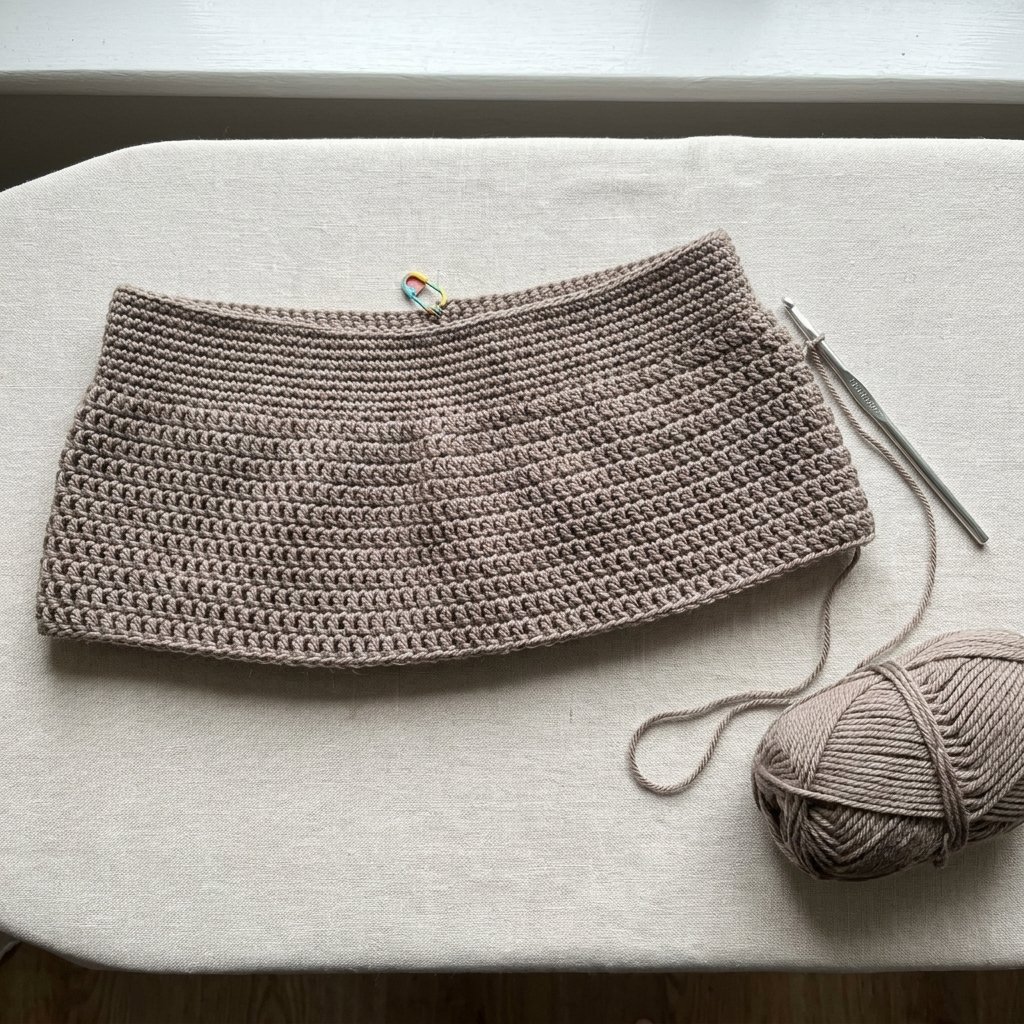
Body Round 1: Ch 2. Dc in each stitch around. Join with a sl st to the first dc. 180 (198, 216, 234) sts.
Body Rounds 2–11: Repeat Body Round 1. The stitch count stays the same.
These first 11 rounds create approximately 4.4 inches (11 cm) of straight fabric below the waistband. The flare begins in the next round.
Part 3 — Shape the A-Line Skirt
Each increase round adds 6 stitches. Use the table below for your size.
For every increase round: ch 2, then repeat [dc in the next listed number of stitches, 2 dc in the next stitch] six times. Join with a sl st to the first dc.
For example, Size A Round 12 is: ch 2, repeat [dc in the next 29 stitches, 2 dc in the next stitch] six times, then join. You finish with 186 stitches.
| Body round | Plain dc before each increase: A (B, C, D) | Finished count: A (B, C, D) |
|---|---|---|
| 12 | 29 (32, 35, 38) | 186 (204, 222, 240) |
| 16 | 30 (33, 36, 39) | 192 (210, 228, 246) |
| 20 | 31 (34, 37, 40) | 198 (216, 234, 252) |
| 24 | 32 (35, 38, 41) | 204 (222, 240, 258) |
| 28 | 33 (36, 39, 42) | 210 (228, 246, 264) |
| 32 | 34 (37, 40, 43) | 216 (234, 252, 270) |
| 36 | 35 (38, 41, 44) | 222 (240, 258, 276) |
| 40 | 36 (39, 42, 45) | 228 (246, 264, 282) |
| 44 | 37 (40, 43, 46) | 234 (252, 270, 288) |
| 48 | 38 (41, 44, 47) | 240 (258, 276, 294) |
| 52 | 39 (42, 45, 48) | 246 (264, 282, 300) |
| 56 | 40 (43, 46, 49) | 252 (270, 288, 306) |
Body Rounds 13–15, 17–19, 21–23, 25–27, 29–31, 33–35, 37–39, 41–43, 45–47, 49–51, and 53–55: Ch 2. Dc in each stitch around. Join. Keep the stitch count from the most recent increase round.
Body Rounds 57–60: Ch 2. Dc in each stitch around. Join. 252 (270, 288, 306) sts each round.
Check the count after every increase round. If it is incorrect, fix that round before continuing; the next increase repeat depends on it.
Part 4 — Adjust the Length and Finish the Hem
At the stated gauge, the 60 body rounds measure approximately 24 inches (61 cm). The folded waistband and edging bring the total length to approximately 25.75 inches (65.5 cm).
For a longer skirt, add plain double crochet rounds after Round 60. Each additional round adds approximately 0.4 inch (1 cm). Keep the final stitch count unchanged.
For a slightly shorter skirt, stop after any completed round from Round 56 onward. This keeps all the planned shaping. For a much shorter version, additional changes to the shaping schedule would be needed.
Hem Round 1: Ch 1. Sc in every stitch around. Join with a sl st to the first sc. 252 (270, 288, 306) sts.
Fasten off. Leave a tail long enough to weave in securely.
Part 5 — Block the Skirt
Wash or dampen the skirt according to the yarn label. Gently remove excess water without wringing, then lay it flat on a towel.
Smooth the fabric into its natural A-line shape. Do not stretch the waistband or pin the hem wider than its intended measurement.
Allow the skirt to dry completely before fitting the elastic. Measure the finished body length again, especially if your swatch showed growth.
Part 6 — Fold the Waistband and Insert Elastic
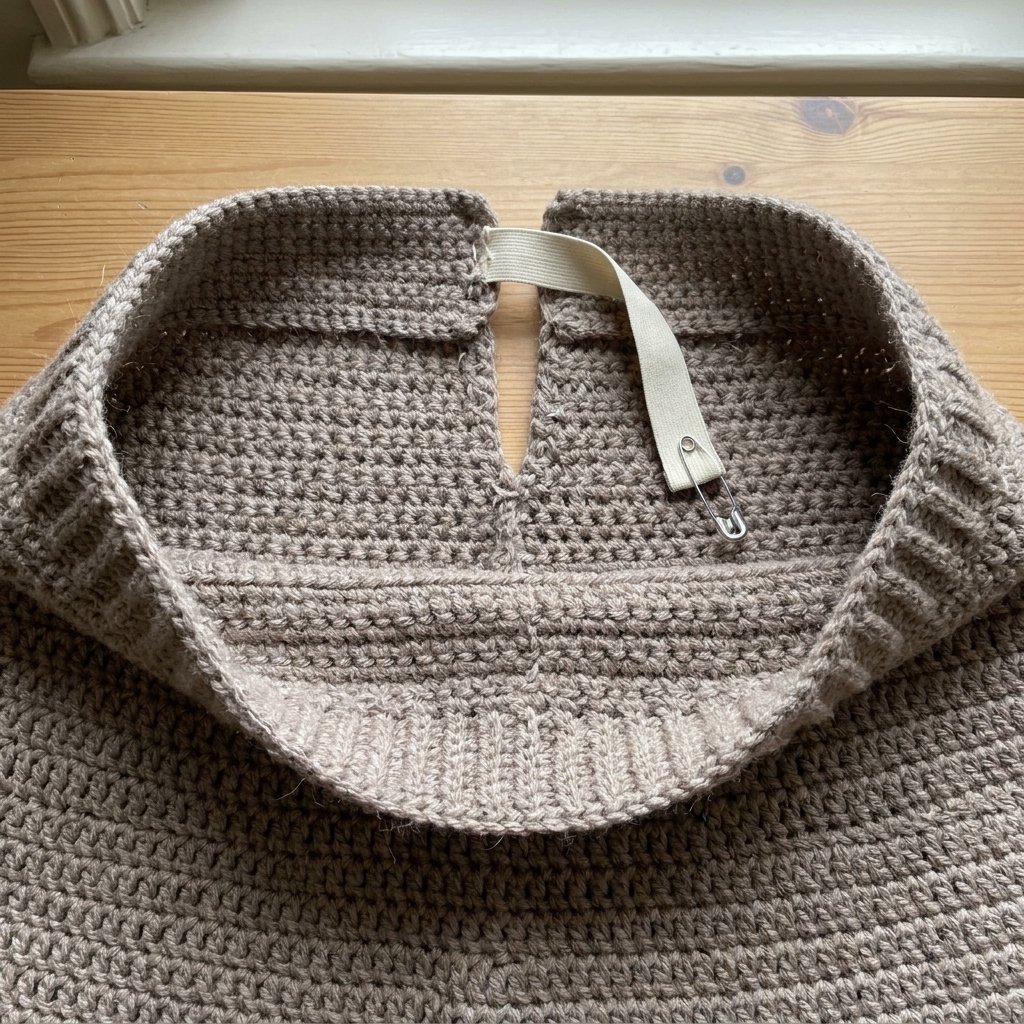
Turn the skirt inside out. Fold the single crochet band in half toward the inside so its foundation edge meets the transition between the waistband and the first body round.
Using matching yarn and a yarn needle, sew the foundation edge to the inside of that transition. Align the stitches and keep the sewing loose enough to preserve the full circumference. Leave a 2-inch (5 cm) opening at the center back.
Wrap the elastic around the place where you want the waistband to sit. Adjust until it feels comfortably supportive, then allow 1 inch (2.5 cm) for the overlapping join before cutting.
Attach the safety pin to one end and thread the elastic through the casing. Keep hold of the other end so it does not disappear inside. Check that the elastic lies flat all the way around.
Overlap the elastic ends by 1 inch (2.5 cm). Baste the overlap together with sewing thread, remove the safety pin, and carefully try on the skirt. Check that it passes over your hips and feels comfortable when sitting.
Adjust the elastic if needed. Secure the overlap with several rows of firm backstitch through both layers, then remove any loose basting thread.
Distribute the gathers evenly. Sew the remaining casing opening closed without catching the elastic.
Finishing
Weave in the yarn ends on the inside, passing through several stitches and changing direction to help secure them. Keep the tails away from the elastic channel.
Check the center-back joins, hem, and casing seam. The waistband should stretch over your hips without the sewing thread or yarn seam pulling tight.
Try the skirt with your intended outfit. Walk, sit, and take a comfortable full step to check the hem allowance. Crochet double crochet fabric may be sheer in bright light, so pair it with a separate slip if you prefer more coverage.

Finished Size
After blocking, the upper-skirt circumferences are approximately 40 (44, 48, 52) inches, or 101.5 (112, 122, 132) cm, before the elastic gathers the waist.
The hem circumferences are approximately 56 (60, 64, 68) inches, or 142 (152.5, 162.5, 172.5) cm.
The standard finished length is approximately 25.75 inches (65.5 cm), measured from the top of the folded waistband to the hem. Where that falls on your leg depends on your height and where you wear the waist.
Tips and Customization
- Choose a wearable color: Match the yarn to a few tops you already enjoy wearing.
- Add subtle stripes: Change color at the beginning of a body round and keep the shaping schedule unchanged.
- Adjust the length: Add plain rounds below the final increase for more coverage.
- Substitute yarn carefully: Match both gauge and drape. A yarn with the same weight label can still behave differently.
- Keep the waistband smooth: Distribute the elastic gathers evenly after washing.
- Store it folded: This helps avoid stretching the garment on a hanger between wears.
Frequently Asked Questions
Is this crochet midi skirt pattern suitable for beginners?
Yes, for beginners who are comfortable counting stitches, working double crochet, and joining rounds. The shaping uses only six simple increases at a time. Swatching and checking the fit are important parts of making the garment.
Why is the waistband wider than my waist?
The crochet band needs to pass over your hips because the skirt has no zipper or button opening. The elastic brings that wider fabric in to fit your waist.
Can I use worsted-weight yarn?
Worsted yarn will usually change the size, weight, and drape. Use DK yarn that matches the stated gauge for this version rather than substituting a thicker yarn with the same stitch counts.
Can I make the skirt without elastic?
This construction depends on elastic to hold the waist securely. Removing it would require a redesigned waistband or another closure.
Does the skirt need a lining?
That depends on your yarn, tension, and preferred coverage. Hold the washed swatch against light before starting. A separate slip is an easy option that does not change the crochet instructions.
Save This Pattern for Later
Save this crochet midi skirt pattern to your crochet clothing board on Pinterest so you can return to the sizing chart and shaping instructions when you are ready to begin.
Looking for Your Next Crochet Project?
Love this project? Explore Cute Stitch Studio’s premium crochet patterns for more cute, cozy, gift-worthy, and beginner-friendly handmade ideas.